|
Oleaceae
FRITZ GROHMANN

Gordon College, Rawalpindi.(Now at St. Georgen, Austria.)
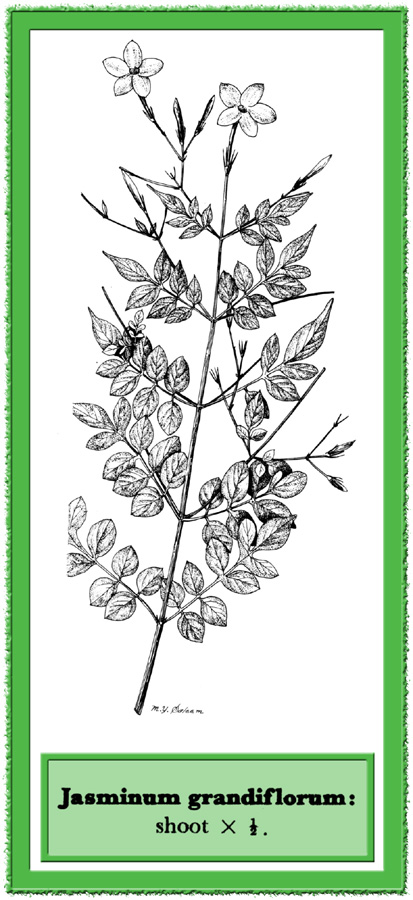
Trees or shrubs, rarely climbers. Leaves exstipulate, opposite (alternate in some species of Jasminum), simple or compound. Inflorescence basically cymose, paniculate or decussate, often with bracts. Flowers bisexual, rarely unisexual. Calyx tubular or campanulate, often very short, (lacking in some species of Fraxinus) truncate or 4(-5-9) lobed. Corolla lacking (in some species of Fraxinus) or tubular, funnel or salver-shaped, lobes 4(-5-10). Anthers 2, epipetalous, usually transversely placed and alternating with the carpels. Gynoecium superior, of 2 united carpels; ovary 2-locular, with 2 anatropous ovules in each locule. Style 1, stigma 2-lobed. Fruit a samara, a capsule, a drupe, or a berry, containing 1-4 seeds.
A family of about 29 genera and 600 species, distributed in tropical, subtropical and temperate regions of the world, especially tropical and temperate Asia. Represented in Pakistan by 8 genera and about 30 species, of which about 22 species are cultivated.
Acknowledgements: We are grateful to the United States Department of Agriculture for financing this research under P.L. 480 we are thankful to Mr. P.S. Green, Asstt. Keeper, The Herbarium Royal Botanical Gardens, Kew, for going through the manuscript and giving valuable suggestions. Our thanks are also due to the Keeper of the Kew Herbarium and the Director, Naturhistorisches Museum, Vienna, for herbarium and library facilities.
|
|
|
|
| 1 |
Leaves compound |
|
(2) |
| + |
Leaves simple |
|
(3) |
| |
|
|
|
| 2 (1) |
Fruit a samara. Leaflets serrate or crenate, rarely
entire |
|
Fraxinus |
| + |
Fruit a berry or a capsule. Leaflets mostly entire |
|
(8) |
| |
|
|
|
| 3 (1) |
Corolla tube orange-red lobes whitish. Leaves covered with short, stiff hairs |
|
Nyctanthes |
| + |
Corolla tube of the same colour as the lobes. Leaves if pubescent, not covered with stiff hairs |
|
(4) |
| |
|
|
|
| 4 (3) |
Corolla 3-5 mm in diameter, creamy-white, some times greenish; tube up to 3 mm long. Fruit a drupe |
|
(5) |
| + |
Corolla 5-35 mm in diameter, white, yellow or red-lilac; tube 5-20 mm long. Fruit a berry or a capsule |
|
(8) |
| |
|
|
|
| 5 (4) |
Leaves lanceolate to ovate, densely covered with
minute whitish or reddish scales, more on the lower
surface. Small tree of greyish-green appearance |
|
Olea |
| + |
Leaves ovate green, sometimes shining not densely
covered with scales. Trees or shrubs, not greyish |
|
(6) |
| |
|
|
|
| 6 (5) |
Leaves bearing glands (domatia) at the axils of nerves |
|
Olea |
| + |
Leaves without such glands |
|
(7) |
| |
|
|
|
| 7 (6) |
Flowers in short racemes or fascicles. Drupe 1-seeded |
|
Osmanthus |
| + |
Flowers in thyrsoid panicles. Drupe with 1-3 seeds,
resembling a berry |
|
Ligustrum |
| |
|
|
|
| 8 (4) |
Fruit a berry. Corolla lobes (4-) 5-10; flowers solitary, in cymes or fascicles |
|
Jasminum |
| + |
Fruit a capsule. Corolla lobes 4; flowers solitary, in panicles or fascicles |
|
(9) |
| |
|
|
|
| 9 (8) |
Corolla tube longer than the lobes, red-lilac or white. Leaves Simple, entire or pinnatifid |
|
Syringa |
| + |
Corolla deeply divided, yellow; tube much chorter than the lobes. Leaves simple, serrate, trilobed or trifoliolate |
|
Forsythia |
|
|
|
Lower Taxa
| Related Links (opens in a new window) |
|
Treatments in Other Floras @ www.efloras.org
Other Databases
|
|
|
|
|
|
|