|
Boraginaceae
YASIN J. NASIR
National Herbarium,Pakistan Agricultural Research Council, Islamabad.
Annual, biennial or perennial herbs or less often shrublets or trees, usually with coarse hairs that arise from a tuberculate base; hairs appressed, subappressed or setose. Leaves alternate, simple, exatipulate. Inflorescence initially a scorpiod or helicoid cynic that uncoils at anthesis, sometimes spicate, loosely cymose or with solitary flowers. Flowers generally regular and bisexual or less often irregular, sometimes heterostylous. Calyx 5-lobed, often enlarging in fruit. Corolla 5 -lobed, salverform, funnelform or campanulate. Throat glabrous or with scales (appendages) or a zone of hairs, a nectiferous ring or collar sometimes present at base of corolla tube. Stamens 5, epipetalous, alternating with the corolla lobes, equal or unequal. Filaments exserted beyond the corolla tube or not. Ovary superior, 4-locular at maturity. Style gynobasic or terminal, usually simple; stigma entire or by splitting of style, 24-lobed. Fruit of 2 or 4 nutlets or drupaceous. Nutlets borne on a gynobase that is flat or raised and fused to the style base, keeled or not, attachment scar (areole) narrow or not; often differentiated into a disc and margin; margin smooth of appendiculate; surface smooth to hairy or variously ornamented.
A family of c. 100 genera and 2000 species distributed in temperate, especially mediterranean and tropical regions. Represented in Pakistan by 32 genera and 135 species of which c. 5 species of Cordia, Echium and Anchusa are cultivated.
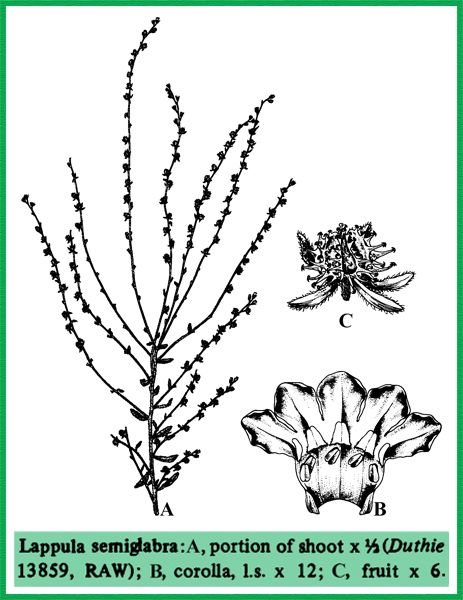
As the flower and especially the fruit are most important diagnostically, it is helpful to elaborate and explain some of the terms used in the text. The corolla size includes the length of the tube and limb. Faucal appendages, as used in some literature is replaced here by “throat scales”. The style which is diagnostic, may sometimes be. split once or twice (Arnebia, Cordia, Ehretia etc.) and hence the term 2-fid or 4-fid. There are generally as many stigmas as there are styles. Various terminology has been used to describe the characters of the nutlets-sometimes of an elaborate nature (M. Popov in Schischkin, Fl. URSS 19:98-100. 1953-English translation, Jerusalem, 1974). The attachment scar (cicatrice) of the nutlet is referred to here as the areole. The gynobase is that part of torus (receptacle) on which the nutlets are borne; its shape varies from flat to elongate and may bear the persistent style at its apex. When the gynobase is flat (Castrocotyle, Lycopsis, Nonea, Echium etc.) the nutlets are said to be basally attached, if ± pyramidal (Cynoglossum, Paracaryum, Solenanthus etc.) then the nutlets are ventrally attached. The nutlets may be variously oriented in relation to their plane of attachment (viz. erect, transverse or oblique). The dorsal middle area (disc) is the side that is turned towards the apex or faces the style (adaxial); it may be rimmed or crested by a thickened ring or flatmargined. The margin may be formed by the fused bases of the appendages, or the appendages may be free. Appendages are glochidiate if they are stiff and apically barbed (Heterocaryum, Cynoglossum, Lappula). Acknowledgements: I am grateful to the Directors/Curators of the following for the loan of herbarium specimens: BM (NH), E, G, GH K, KUH, M, PES, PPFI-B, US, W. I am also thankful to Mr. I. C. Hedge (EdinbuRGH) for going though the manuscript and for his helpful advice. The financial assistance received from the United States Department of Agriculture under P1,480 is gratefully acknowledged.

|
|
|
|
| 1 |
Trees or shrubs |
|
(2) |
| + |
Herb, sometimes with a suffruticose base, rarely shrubs |
|
(3) |
| |
|
|
|
| 2 (1) |
Style 4-fid |
|
1 Cordia |
| + |
Style 2-fid. |
|
2 Ehretia |
| |
|
|
|
| 3 (1) |
Style terminal. |
|
(4) |
| + |
Style gynobasic. |
|
(5) |
| |
|
|
|
| 4 (3) |
Styles 2, not dilated towards apex or base. |
|
3 Coldenia |
| + |
Style 1, dilated towards apex or base. |
|
4 Heliotropium |
| |
|
|
|
| 5 (3) |
Fruit with 2 nutlets. |
|
25 Rochelia |
| + |
Fruit with 4 nutlets, at least in young stage. |
|
(6) |
| |
|
|
|
| 6 (5) |
Corolla distinctly zygomorphic |
|
(7) |
| + |
Corolla actinomorphic |
|
(8) |
| |
|
|
|
| 7 (6) |
Gynobase flat. Style usually 2-fid at apex, rarely entire. Nutlets without a lateral attachment |
|
8 Echium |
| + |
Gynobase pyramidal. Style simple. Nutlets with a sessile lateral attachment |
|
9 Echiochilon |
| |
|
|
|
| 8 (6) |
Tips of anthers elongated and contorted |
|
16 Trichodesma |
| + |
Tips of anthers obtuse or apiculate, not contorted |
|
(9) |
| |
|
|
|
| 9 (8) |
Stamens unequal, with 1 anther larger than the other four |
|
15 Caccinia |
| + |
Stamens of equal size |
|
(10) |
| |
|
|
|
| 10 (9) |
Corolla throat with scales absent; throat sometimes villous |
|
(11) |
| + |
Corolla throat with scales present; sometimes sparsely hairy or with small glands |
|
(15) |
| |
|
|
|
| 11 (10) |
Flowers nodding at anthesis; corolla lobes reduced. Anther connective elongated |
|
17 Onosma |
| + |
Flowers ± erect; corolla lobes distinct. Anther connective not elongated |
|
(12) |
| |
|
|
|
| 12 (11) |
Corolla throat vinous. Style simple |
|
14 Sericostoma |
| + |
Corolla throat glabrous. Style divided |
|
(13) |
| |
|
|
|
| 13 (12) |
Corolla throat glabrous. Style 24-fid, rarely undivided; stigmas 2-4 |
|
5 Arnebia |
| + |
Corolla throat glabrous to hairy; style 2-fid; stigmas 2 |
|
(14) |
| |
|
|
|
| 14 (13) |
Annuals. Corolla throat hairy. Nutlets ± pear shaped, surface tuberculate or rugose |
|
7 Buglossoides |
| + |
Perennials. Corolla throat not hairy. Nutlets ovoid |
|
6 Lithospermum |
| |
|
|
|
| 15 (10) |
Margin and middle dorsal area of nutlets glabrous to hairy or variously ornamented but never prickly or appendiculate |
|
(16) |
| + |
Margin and middle dorsal area of nutlets prickly or appendiculate |
|
(23) |
| |
|
|
|
| 16 (15) |
Calyx irregular; much enlarged (12-14 mm) and saucer-like in fruit: lobes unequal, dentate in between |
|
18 Asperugo |
| + |
Calyx regular, not much enlarged (up to 10 mm) in fruit; lobes equal or subequal, not dentate in
between |
|
(17) |
| |
|
|
|
| 17 (16) |
Throat scales fimbriate or densely pubescent. Areola prominently hollowed, with a thick girdle |
|
10 Nonea |
| + |
Throat scales not fimbriate, glabrous or puberulous. Arcola not prominently hollowed out |
|
(18) |
| |
|
|
|
| 18 (17) |
Calyx in fruit stellately spreading |
|
12 Gastrocotyle |
| + |
Calyx in fruit not stellately spreading |
|
(19) |
| |
|
|
|
| 19 (18) |
Flowers axillary (at least lower ones |
|
13 Bothriospermum |
| + |
Flowers in terminal cymes |
|
(20) |
| |
|
|
|
| 20 (19) |
Areole of nutlet with surface of attachment concave, margin prominently thickened |
|
11 Anchusa |
| + |
Areole of nutlet with surface of attachment flat, margin not thickened |
|
(21) |
| |
|
|
|
| 21 (20) |
Perennials. Corolla infundibuliform or cylindrical-campanulate, blue to deep purple-blue |
|
21 Pseudomertensia |
| + |
Annual or perennial. Corolla rotate or hypocrateriform, blue or white |
|
(22) |
| |
|
|
|
| 22 (21) |
Flowers ebracteate. Nutlets smooth |
|
19 Myosotis |
| + |
Flowers (at least the lower ones) bracteate. Nutlets minutely tuberculate |
|
20 Anoplocaryum |
| |
|
|
|
| 23 (15) |
Nutlets attached laterally to the gynobase and decurrent on style |
|
(24) |
| + |
Nutlets not as above |
|
(25) |
| |
|
|
|
| 24 (23) |
Dorsal middle area of nutlet partly covered by the incurved margin |
|
27 Paracaryum |
| + |
Dorsal middle area of nutlet not covered by the margin |
|
28 Mattiastrum |
| |
|
|
|
| 25 (23) |
Middle area of nutlet ovate; inner face above areola keeled throughout its length |
|
29 Lepechiniella |
| + |
Middle area of nutlet not ovate; inner face above areola not keeled throughout its length |
|
(26) |
| |
|
|
|
| 26 (25) |
Nutlets inseparable from gynobase; base of |
|
30 Heterocaryum |
| + |
Nutlets separable from gynobase; bases of marginal appendages usually not confluent |
|
(27) |
| |
|
|
|
| 27 (26) |
Nutlets ± globose or napiform |
|
(28) |
| + |
Nutlets pyramidal to truncate-pyramidal-oblong |
|
(30) |
| |
|
|
|
| 28 (27) |
Filaments longer than anthers, attached above throat scales. Stamens distinctly exserted |
|
31 Solenanthus |
| + |
Filaments equalling anthers, attached below throat scales. Stamens included or barely exserted |
|
(29) |
| |
|
|
|
| 29 (28) |
Corolla rotate, the tube not exceeding calyx length. Stamens included |
|
26 Cynoglossum |
| + |
Corolla funnel-shaped, tube exceeding calyx length. Stamens exserted |
|
32 Lindelofia |
| |
|
|
|
| 30 (27) |
Nutlets ± equalling the gynobase length, attach-ed for nearly the whole length;, but not over topping the calyx |
|
24 Lappula |
| + |
Nutlets exceeding the gynobase and style, attached obliquely |
|
(31) |
| |
|
|
|
| 31 (30) |
Tall plants with broad leaves. Fruiting calyx reflexed |
|
22 Hackelia |
| + |
Generally caespitose plants with small narrow leaves. Fruiting calyx not reflexed |
|
23 Eritrichium |
|
|
|
List of lower taxa
| Related Links (opens in a new window) |
|
Treatments in Other Floras @ www.efloras.org
Other Databases
|
|
|
|
|
|
|